
Scena da La guerre est finie (1966)


Dettagli della scena
| Durata: 155 sec.. | Nudità: yes | Creatore: supers992 |
| Nuova dimensione file: Loading... | Audio: yes | Vecchia dimensione file: 392 mb |
| Formato file: AOMedia Video 1 (WebM/AV1) | Risoluzione: 1792x1080 | Aggiunto: 2026-04-12 |
Attrici in questa scena

Nome di nascita: Ingrid Lilian Thulin
Data di nascita: 1926-01-27
Luogo di nascita: Sollefteå, Sollefteå Municipality, Sweden
Dettagli
Nomi alternativi: Ingrid Lilian Thulin, Ingrid Tulean, Ингрид Тулин
Caratteristiche fisiche: N/A
Carriera
Prime apparizioni:
Ruoli più importanti:
Punti salienti della carriera:
Premi
Premi:
Biografia completa
Ingrid Lilian Thulin (Swedish pronunciation: [ˈɪŋːrɪd tɵˈliːn]; 27 January 1926 – 7 January 2004) was a Swedish film actress.
Thulin was born in Sollefteå, Ångermanland, northern Sweden, the daughter of Nanna (née Larsson) and Adam Thulin, a fisherman. She took ballet lessons as a girl and was accepted by The Royal Dramatic Theatre ("Dramaten") in Stockholm 1948.
For many years she worked regularly with Ingmar Bergman; among other films, Thulin appeared in Bergman's Wild Strawberries (1957), The Magician (1958, where she acted dressed as a boy), in Winter Light (1962), as well as The Silence (1963) and Cries and Whispers (1972).
She shared the Best Actress award at the 1958 Cannes Film Festival and received a Guldbagge Award for Best Actress in 1964, the first year the award was given out, for her performance in The Silence. Winner of the David di Donatello Awards 1974, Thulin was also been nominated for the BAFTA Award the same year. In 1980, she was the head of the jury at the 30th Berlin International Film Festival.
She was married to Harry Schein, the founder of the Swedish Film Institute, for more than 30 years until 1989, although they had lived separately for many years before the divorce. She bought an apartment in Paris, France in the early 1960s and some years later a beach house in San Felice Circeo. In 1970 she became a resident of Sacrofano, Italy, where she lived for 34 years. She returned to Sweden for medical treatment and later died from cancer in Stockholm, Sweden, 20 days shy of her 78th birthday.
Sul film: La guerre est finie (1966)
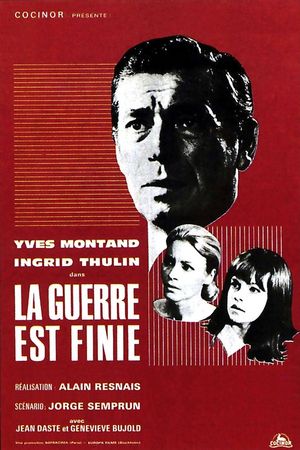
Titolo alternativo: La guerra ha terminado, De oorlog is gedaan, A Guerra Acabou, Войната свърши, Krigen er endt, Sota on loppunut, Der Krieg ist vorbei, O polemos teleiose, A háborúnak vége, La guerra è finita, 戦争は終った, Krigen er slutt, Wojna się skończyła, Война окончена, Kriget är slut, Savaş Bitti, The War Is Over
Regista: Alain Resnais
Sceneggiatore: Jorge Semprún
Produzione & Genere
Produttore/i: Producer: Gisèle Rebillon, Catherine Winter, Anatole Dauman
Società: Argos films, Europa Film, Sofracima
Premi & Simili
Premi:
Simile:
Parole chiave
Parole chiave: 1960s, anti-fascism, clandestine life, communist infiltrator, exiled spanish republican, franco regime (francoism), paris, france, post spanish civil war, spain, terrorist group
Storia
Diego, a high-ranking member of the Spanish Communist Party, returns to Paris from Madrid after completing a mission. At the border crossing, he is arrested for an ID check but manages to evade capture with the help of Nadine, the daughter of the man whose passport he's using. Once in Paris, Diego sets out to find his comrade Juan before Juan can return to Spain and risk arrest by Franco's police. Diego must navigate a web of secrecy and danger as he tries to protect his friend while also avoiding capture himself.
Riassunto
La guerre est finie (1966) is a French-Swedish drama directed by Alain Resnais, set against the backdrop of post-World War II Europe and the lingering effects of the Spanish Civil War. The film follows Diego, an exiled Spanish republican communist infiltrator living in Paris during the 1960s. It explores themes of clandestine life, anti-fascism, and the struggle to maintain hope amidst oppressive regimes like Franco's. Resnais masterfully captures the tension and anxiety of those living in exile while fighting against fascism.